A Thousand Bulbs and a Biscuit Tin: How One House Ends Up Lighting the Whole Street
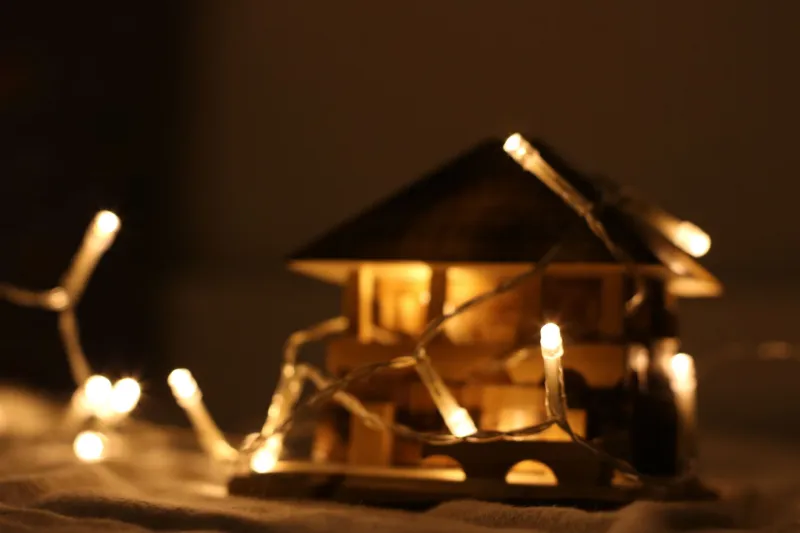
Somewhere near you is a house with a timetable. You may not know it yet. But by the first week of December, you’ll notice a glow at the end of a cul-de-sac, a slow crawl of parked cars, and a family in matching bobble hats pretending not to be directing traffic. Britain’s unofficial Christmas lights houses aren’t organised by councils or funded by anyone with a marketing budget. They’re a domestic hobby that got out of hand — and then got adopted by an entire street.
It starts with one extension lead
The story rarely begins with a grand plan. It begins with a box of lights in the loft, a trip to a garden centre, and a vague ambition to “do the front bit properly this year.” Then someone discovers the hedge looks better with a net, the hedge’s friend the porch looks left out, and before long there’s a bloke on a stepladder at 9am on a Saturday explaining to a neighbour that he’s “just testing a few ideas.”
By the following December, the testing has become a system. There are extension leads with labels on them. There is a laminated diagram. There is a debate about whether the inflatable snowman counts as tasteful, and a quiet agreement that tasteful was never really the point.
The person behind it is usually not a professional electrician. They’re a person with a spreadsheet, a tolerant partner, and a strong opinion about which garden centre sells the warm-white bulbs that don’t look like a dental waiting room. They will tell you it’s “not that much work.” They will also be outside in the rain on 29 November, muttering at a fuse.
The unofficial committee
What makes these houses interesting isn’t the wattage. It’s the way a street reorganises itself around them. The neighbour two doors down becomes an information desk: yes, it’s on until about 9pm; no, you can’t walk on the lawn; yes, the inflatable snowman does deflate if it rains, and no, nobody knows why.
Someone else starts putting the bins out earlier so the pavement stays clear. A third neighbour lends a ladder, then a second ladder, then stands at the bottom of the first ladder saying “that’s it, a bit left” in the tone of a man who has found his calling. Nobody elects this committee. It simply forms, the way a queue forms at a bus stop or a WhatsApp group forms after a street party.
And then there’s the switch-on. In many streets it’s a low-key affair — a plug, a countdown, a small cheer, maybe a flask. In others it has become a genuine 6pm appointment, with children in pyjamas under coats and adults holding mugs as if attending a civic ceremony. Which, in a way, they are.
The etiquette of the glow
Visiting a Christmas lights house comes with unwritten rules, and most of them are about being a decent human being in a residential road. Don’t block driveways. Don’t leave engines running while you gawp. Don’t touch the displays, however tempting the giant present stack looks. And if the owners are outside, a quick “lovely job” goes a long way — it’s the street-level equivalent of leaving a five-star review.
The best visitors arrive with a little patience. These houses are not theme parks. They’re someone’s front garden, with all the ordinary chaos that implies: a wheelie bin just behind the reindeer, a forgotten watering can, a child’s bike parked at an angle that slightly ruins the shot. That’s part of the charm. A perfectly curated display is impressive; a display with a wheelie bin in it is Britain.
The biscuit tin by the gate
Look closely and you’ll often find a tin. Sometimes it’s a biscuit tin with a slit cut in the lid; sometimes it’s a proper collecting box with a laminated sign for a local hospice, food bank or air ambulance. The lights are free to look at, but the tin is there for anyone who wants to turn a nice evening into something useful.
What’s striking is how quietly it works. Nobody is counting. Nobody is chasing. The tin fills up in coins and the odd folded fiver, and the household empties it at the end of the run with the same matter-of-factness as taking the recycling out. It’s charity as a side effect of neighbourliness, which may be the most British arrangement of all.
When the street adopts you
Not every lights house sets out to become a landmark. Some do it for the kids, some do it for a late relative, some do it because December is dark and the garden looks better lit. But once the street adopts you, the thing takes on a life of its own. People bring friends. Friends bring children. Children bring the same question every year: “Can we go to the lights house?”
And the household, despite the mud, the extension leads and the neighbour who keeps suggesting a giant inflatable, tends to keep going. Because the lights have stopped being just lights. They’ve become a small ritual in a calendar that can feel a bit thin on rituals. A reason to walk somewhere after dark. A reason to say hello to someone you usually only nod at.
This December, as 2026 shuffles towards its end, the 6pm switch-on will happen again on streets up and down the country. The bulbs will go on. Someone will applaud. Someone else will say “ooh, that’s bright.” And a ordinary road will remember, for a few weeks at least, that it’s a street.