Take a Book, Leave a Book, Mind the Geraniums: Britain’s Front-Garden Libraries
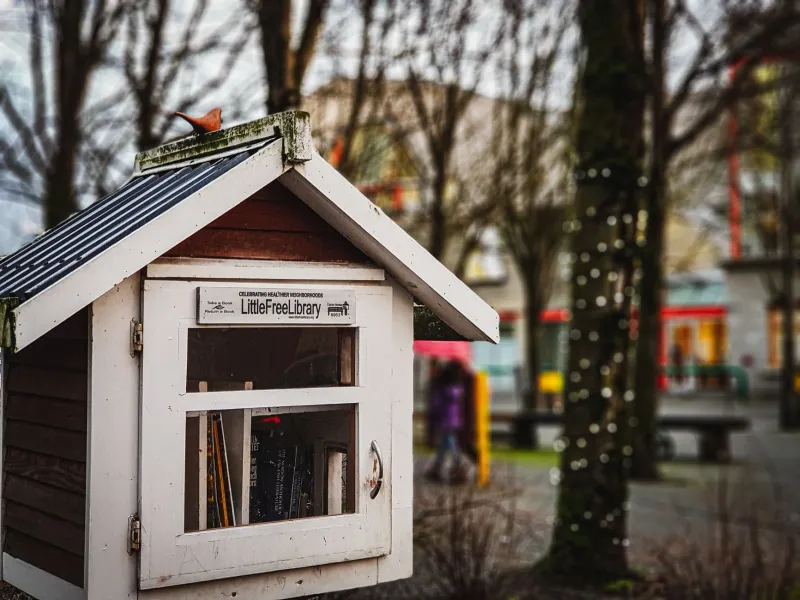
There’s a particular kind of British magic in walking past a stranger’s front wall and being invited, wordlessly, to borrow a book. No card, no fee, no librarian giving you a hard stare over her glasses. Just a wooden box on a post, a laminated sign that says ‘Take one, leave one, enjoy’, and the faint smell of damp paper and someone else’s hand cream.
These tiny front-garden libraries have quietly become part of the street furniture in 2026. You’ll find them in old phone boxes in Yorkshire villages, on shelves screwed to pub porches in Somerset, and in repurposed biscuit tins chained to railings in South London. They are gloriously unregulated, mildly chaotic, and one of the last places where you can judge a neighbourhood by its reading taste.
The telltale signs of a well-stocked box
A good little library announces itself. Look for a waterproof roof (essential), a clear glass door (so you can browse without committing), and a small pot of pens or a stack of sticky notes nearby. The best ones have a theme — crime fiction in one, gardening manuals in another, a surprisingly robust section on local walks — and a handwritten inventory taped inside the lid.
You can usually tell within seconds whether a box is loved. If the spines are facing outwards and the poetry isn’t shoved to the back behind a Weight Watchers cookbook from 2004, someone is tending it. If there’s a little guestbook or a notebook for recommendations, even better. That’s not a library; that’s a conversation.
In 2026, the truly ambitious ones have solar fairy lights, a tiny bench, and a sign saying ‘Please don’t leave Fifty Shades, we’ve got six’. You have to respect the honesty.
The unwritten etiquette (and the slightly written one)
The rules are simple, but they are not optional. Take a book, leave a book is the headline act. Leaving two is generous; leaving none is daylight robbery. Leaving a book you wouldn’t wish on your worst enemy is a grey area — technically allowed, socially frowned upon. If it’s a diet manual from the 1980s, maybe pop it in a charity shop instead.
Do not rearrange the shelves. The owner has a system, even if that system is ‘wherever it fits’. Do not cram books in so tightly that the door won’t shut. And for the love of all that is holy, do not treat it as a recycling bin for water-damaged paperbacks. A little library is not a skip with a roof.
If you borrow, return it when you’re done — or pass it on to another box. The books are meant to travel. Finding a faded stamp from a library in Cornwall inside a paperback you picked up in Newcastle is a small thrill, like a message in a bottle.
The pencilled notes are the whole point
Here’s the thing that separates a front-garden library from a charity shop shelf: the marginalia. A stranger’s pencilled note in the margin — ‘don’t trust the sister’, ‘this bit made me cry on the bus’, ‘page 94 is nonsense, skip it’ — is a tiny act of companionship. You don’t know who wrote it. You never will. But for a few hundred pages, you’re reading together.
Some boxes have a notebook tucked inside where people leave reviews. ‘Found this on a rainy Tuesday, read it in two days, left it in the phone box near the chippy.’ That’s not a review; that’s a short story. If you find a box with a notebook, read it before you browse the shelves. It tells you more about the neighbourhood than any estate agent’s blurb.
How to spot the best boxes in 2026
Word of mouth is still the best map. Ask in the local Facebook group, check the parish newsletter, or just walk the same route twice. The best ones are usually on streets with a primary school, a corner shop, and at least one person who grows courgettes to give away.
Look for signs of curation: a small ‘New in’ shelf, a seasonal display (ghost stories in October, gardening in March), a little tin for donations towards the paint. If the box has a name — ‘The Book Nook’, ‘Pat’s Pages’, ‘The Reading Retreat’ — you’re onto a winner. Pat knows what she’s doing.
And if you find one that’s empty? Don’t judge. Come back with a book. That’s the whole point.
Starting your own (without annoying the neighbours)
First, check your front wall isn’t listed, your landlord isn’t furious, and your box won’t block the pavement. A simple wooden cupboard on a post is plenty. Make it waterproof. Add a little sign explaining the rules. Then tell no one and let it happen organically — or tell everyone on the local WhatsApp group and accept that you’ll be restocking daily for a fortnight.
The trick is to start small. A shelf of ten books is less intimidating than a full bookcase. Mix it up: a few thrillers, a cookbook, a children’s book, something slightly odd that someone will pick up out of curiosity. Keep it tidy, keep it dry, and don’t take it personally when someone leaves a diet manual from 1993. It’s a library, not a curated exhibition.
And if a neighbour asks what you’re doing? Tell them the truth: you’re running the smallest, friendliest branch library in Britain. They’ll either roll their eyes or bring you a carrier bag of Jeffrey Archer. Either way, the street just got a little more interesting.