Six Eggs, a House Brick and a Jam Jar Full of Coins: The Quiet Genius of Britain's Driveway Shops
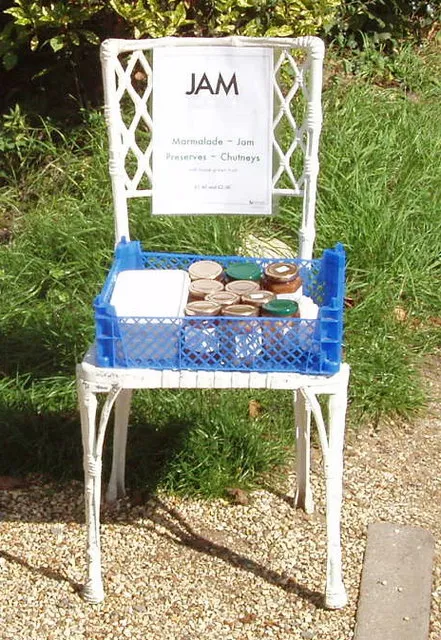
Photo: David Hawgood, CC BY-SA 2.0, via Wikimedia Commons
There's a particular kind of British table that never appears in furniture catalogues. It's the one at the end of a driveway, slightly wonky, often covered in a tea towel that's seen better decades. On it: half a dozen eggs in a reused carton, a pyramid of courgettes, maybe a jar of marmalade with a handwritten label. And next to it, a jam jar of coins, a tub of Pound coins, or — increasingly — a laminated sign with a QR code that's been rained on twice and still, somehow, works.
The stall is not a shop. It's more of a mood. It sits somewhere between a farmers' market and a fairy door, and it might be the most quietly efficient piece of community infrastructure in the country.
The maths of a jar of marmalade
Let's be honest about the economics, because the sellers certainly are. A jar of homemade marmalade at £3.50 does not cover the sugar, the oranges, the jars, the labels, the electricity, or the four hours of stirring while Radio 4 burbles in the background. Add the cost of the stall itself — a fiver for the trestle from a car boot, the price of a Sharpie — and you're deep in the red before anyone's even lifted the lid.
"I worked out I'm making about 40p an hour," says Ruth, who runs a stall near Ludlow with a rotating cast of preserves, plant cuttings and the occasional bag of windfall apples. "But that's not really the point. The point is that someone knocked on the door last week to say the lemon curd was the best they'd had since their mum's. You can't put a price on that. Well, you can — it's £3.50 — but you know what I mean."
The maths barely works. And yet the stalls keep appearing, from the lanes of Suffolk to the edges of Peak District villages, from Highland passing places to the cul-de-sacs of suburban Cardiff. Something else is going on.
A brick is a contract
The honesty box is the whole trick. Leave a brick on the lid, a sign that says "eggs £2.50 a half dozen, please don't take the box", and something remarkable happens: most people pay. Not everyone — there's always one — but enough that the system keeps ticking over.
It's a small, daily act of faith. The seller trusts the stranger; the stranger, weirdly, wants to be trusted. There's a particular pleasure in dropping coins into a jar with nobody watching, like you've joined a secret club whose only rule is "don't be a lemon".
Some stalls have gone full fintech. A QR code taped to a Tupperware lid, a laminated "bank transfer" note, even the odd card reader that's been carefully zip-tied to a fence post. Others remain proudly analogue: coins only, exact change appreciated, no refunds on the courgettes.
The courgette problem (and other gluts)
Every August, Britain is buried under courgettes. Anyone with an allotment knows the feeling: you turn your back for a weekend and suddenly there's a marrow the size of a small dog. The roadside stall is where that glut goes to find a home.
It's not just courgettes. There are stalls selling runner beans, rhubarb, bunches of sweet peas in jam jars, pots of strawberry jam, duck eggs, plant seedlings, bags of kindling, and — in one memorable case near Hexham — a carefully labelled box of "surplus parsnips, slightly bendy, 50p".
The stall is a pressure valve for abundance. It's also a small act of optimism: the belief that someone, somewhere, wants a bendy parsnip. And someone usually does.
When the stall gets ambitious
Most stalls stay modest. But every so often one goes rogue. In a village outside Norwich, a retired carpenter built a little wooden honesty hut with a proper shelf, a hooks for bags, and a sign promising "eggs, honey, and gossip". In Cumbria, a stall now sells homemade dog biscuits and a range of chutneys named after local hills. In one corner of Somerset, there's a table offering "mystery jam — £2, no questions".
The best ones develop a personality. Regulars know which stall has the good eggs, which one sells out of marmalade by Tuesday, and which one has a resident cat that must be acknowledged before any transaction can take place. They become landmarks. People give directions by them: "Turn left at the egg table, past the courgette stall, and you're there."
Why bother, then?
Ask the sellers and the answers are similar. It's not really about the money — though a few quid towards the chicken feed is nice. It's about the small daily contact. The wave from a regular. The note left in the jar saying "thank you, best tomatoes ever". The sense that the street is not just a row of houses but a place where things happen.
"I started it during the lockdowns because I had too many eggs," says Priya, whose stall in a Leicestershire village now sells eggs, chutney and, oddly, secondhand paperbacks. "Now I'd miss it if I stopped. It's how I know what's going on. Someone stops, we chat, I find out whose shed blew down. It's better than the local Facebook group, and there's less arguing."
There's something else, too. In a year when the price of everything has been poked and prodded, the roadside stall is a reminder that not every transaction has to be optimised. Sometimes a jar of coins and a house brick are enough.
How to be a good customer
A few gentle rules, learned from the stalls themselves. Take the right change. Don't haggle — it's already cheap. Put the lid back on the jar properly, because the wind is not your friend. If you take the last of something, leave a note so the seller knows. And if you see a brick, don't move it. The brick is doing important work.
So next time you're driving down a lane and spot a wobbly handwritten sign, pull over. Buy six eggs, a jar of something cloudy, and a courgette you'll probably forget about. Drop your coins in the jar. It's the friendliest transaction on the high street — even when the high street is a driveway and the shopfront is a tea towel.