The Engine Idles, the Shelf Opens: A Morning on Britain’s Mobile Library Round
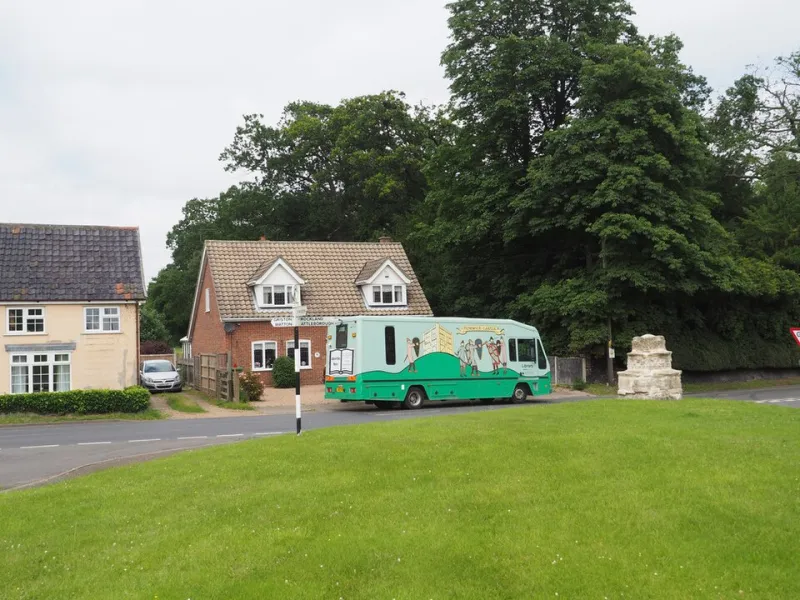
Photo: David Pashley , CC BY-SA 2.0, via Wikimedia Commons
The van arrives at 10.12, not 10.10, and half the cul-de-sac already knows. It is not a bus, not a delivery, not a food truck with a chalkboard menu. It is a library with a handbrake, a grab rail and a timetable taped to the inside of the door. At a lay-by behind the village hall, a woman called Maureen is waiting with a tote bag and a question about large print. Behind her, a man in a fleece is pretending he has come out for the paper. He has not. He has come for the crime shelf.
Welcome to the mobile library round: part public service, part weekly soap opera, part rolling community hall. In 2026, when so much of life has been flattened into an app, there is still something quietly brilliant about a vehicle that turns up with a shelf of books and a driver who knows your name, your reading taste and the fact that your knee has been playing up.
The stop that runs on returns and gossip
A mobile library stop is not a shop. Nobody is trying to upsell you a three-for-two. The pace is slower. Someone returns four paperbacks and takes out two. Someone else asks whether the new Jack Reacher has come in. A toddler makes a break for the board books while a parent performs the familiar one-handed catch. The driver-librarian, who has done this route for years, answers three questions at once: one about reservations, one about the next stop and one about whether the van will be back before Christmas.
It will. It always is, unless there is snow, a road closure or a tractor doing something imaginative in a gateway.
The books are the reason for the van. The chat is the reason people come out of their houses. You can borrow a novel and a bit of company in the same ten-minute visit. On a wet Tuesday in a village with no shop, that is not a small thing. It is the difference between a week with a plot and a week without one.
A route planned by hills, school runs and one very tight corner
From the outside, the route looks simple: a list of stops, a list of times, a driver with a flask. From the inside, it is a small work of local geography. The route planner has to think about parking, turning circles, school drop-off, bin day, the narrow bit by the church and the estate where the mobile signal drops but the demand for audiobooks does not. Some stops get twenty-five minutes. Some get fifty. A hilltop farm might get a quick stop with the ramp down and the driver keeping half an eye on the weather.
The timetable is not just a timetable. It is a social map. The stop outside the sheltered housing gets a steady trickle from nine until half past. The one by the primary school is chaos at pick-up and calm at ten in the morning. The estate stop is busier in school holidays. The village hall stop is where the jigsaw borrowers gather, because the village hall has a table and the jigsaw borrowers have opinions.
And yes, the driver knows the regulars. Not in a creepy way. In a 'your reservation is in, love, and I’ve put the large print one aside for your mum' way. That is the whole trick. The van does not just bring books to people. It brings the library’s memory of people to people.
The regulars: toddlers, teenagers and the ninety-four-year-old critic
On board, the cast changes with each stop. A retired teacher returns four novels and asks for something gripping but not too gruesome. A dad with a toddler in a rain suit borrows three picture books and admits he has not finished his own since March. A teenager slinks in for a manga volume and leaves before anyone can ask how school is going. A ninety-four-year-old regular hands back a biography and delivers a verdict: 'Too much politics, not enough gossip.'
This is the joy of the mobile library. It is not a silent reading room. It is a small, moving public space where people behave roughly as they would in a corner shop: a bit nosy, a bit kind, mostly pleased to see each other. The van gives them a reason to stand in a lay-by and talk about something other than the weather. Although, to be fair, they also talk about the weather.
A loose field guide to on-board etiquette
Mobile library etiquette is not written down, but it is felt. A few helpful notes for the uninitiated:
- Step up one at a time. The grab rail is there for a reason, not decoration.
- Say hello to the driver. They are not a self-service machine with a lanyard.
- Have your card ready, or at least know roughly where it is. The bottom of a handbag is not a filing system.
- Returns go in the crate. Do not reshelve them yourself unless you fancy a career in cataloguing.
- Do not apologise for a late return. The library is just glad to have the book back. Save your apology for the jigsaw you lost a piece of in 2019.
- Ask for a recommendation. The driver has spent all week watching what people borrow. They are a walking algorithm with a thermos.
- Keep the doorway clear. The van is small. Your chat is lovely. Your chat in the doorway is a traffic jam.
- If you borrow a jigsaw, check the pieces. This is not etiquette. This is survival.
When the van is the only branch for miles
It is easy to be romantic about the mobile library. The truth is more practical. Many rural and edge-of-town communities have lost shops, banks, post offices and bus routes. The mobile library is one of the few services that still comes to them. It is not a replacement for a proper branch. It cannot be everything. But it does something a branch cannot do: it turns up.
That matters to people who cannot easily get into town, and it matters to people who could but do not. The van is a low-pressure way back into public life. You do not need to buy a coffee or explain why you are there. You just need to climb the step and say hello. The shelf is open. The driver is listening. The timetable says you have twenty-five minutes, but nobody is counting too strictly.
As the van pulls away, Maureen is already reading the first page of her large print mystery. The man in the fleece is pretending he only came out for the paper again. The toddler has a board book about a digger. The jigsaw borrowers are arguing gently about whether the sky should be sorted first. The engine idles, the shelf closes and the whole street goes back to its day. Same time next week. Due back by Friday, but not before a chat.