The Dish That Does the Rounds: A Friendly Field Guide to the Street Meal Train
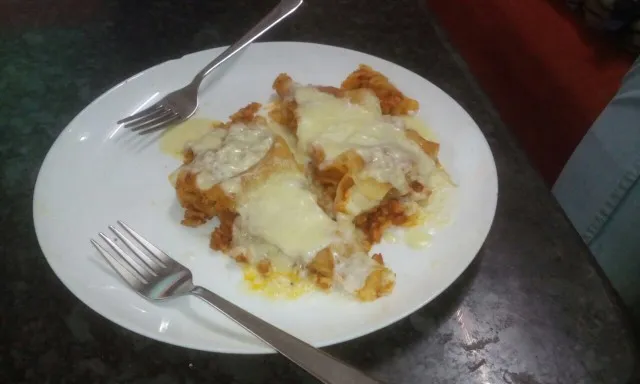
Photo: Edible Encyclopaedia, CC BY-SA 4.0, via Wikimedia Commons
On a grey Tuesday in November, a lasagne leaves number 14. It is still warm. It is wrapped in a tea towel, balanced in a foil tray, and carries a small square of masking tape with 'Veg — 12 Nov' written in biro. By six o'clock it will be at number 22. By Thursday it will have spawned a shepherd's pie, two tubs of soup and a loaf of banana bread. This is the Tupperware relay — or, as most streets call it, the meal train.
It is not a charity campaign. It is not a subscription. It is a chain letter made of carbohydrates, and it is one of the quietest, kindest systems in British street life. It rolls into action for new babies, hospital stays, bereavements and bad weeks. You will not see it on a council leaflet. You will see it on a doorstep, still steaming, with a note that says 'no need to return the tub'.
A relay baton made of pasta
The lasagne at number 14 was made by Dev, a secondary-school art teacher who cooks when he is anxious. He heard from the woman at number 12 that the household at number 22 had come home from hospital with a newborn and a toddler and a washing machine that had chosen this exact moment to die. Dev did not ask for a rota. He just made a lasagne. 'I doubled the sauce and used two trays,' he says. 'One for them, one for us. It's not heroic. It's just tea.'
The first tray went to number 22. The second tray went to number 6, where a neighbour was recovering from a knee operation. At number 6, the lasagne was decanted into a clean dish because the household has a dairy allergy, and the original foil tray was passed to number 31 with a bag of frozen peas. At number 31, the foil tray was washed, labelled 'return to Dev at 14' and left on a garden wall. The lasagne itself had already been eaten. The tray had a longer journey than most of us.
The unwritten etiquette of foil and freezer tape
Meal-train etiquette is not complicated, but it is specific. It is 90 per cent foil and 10 per cent emotional intelligence. The first rule: do not send your best Pyrex unless you trust the person with your best Pyrex. Foil containers, the kind you buy in packs of ten from the supermarket, are the currency of the relay. They can be recycled, stacked, frozen and — crucially — forgotten without guilt.
The second rule: label everything. Not just the date, but the contents and the allergens. 'Chicken pie — 14 Nov — contains gluten and dairy' is a love letter in its own way. The third rule: do not return a tub empty unless you have agreed to return it empty. A clean tub with a bunch of daffodils in February is a small, perfect reply. A clean tub with nothing at all is fine too, as long as it goes back to the right house. The great Tub Mix-Up of a street in Leeds is still spoken of in hushed tones. Do not become a Tub Mix-Up.
Please don't turn it into a group-chat job
The fastest way to kill a meal train is to create a spreadsheet with fourteen columns and a colour-coded tab for dietary requirements. The second fastest is to ask the person who has just had a baby to 'jump on a quick call to discuss likes and dislikes'.
Sharon, a retired teaching assistant who has organised more meal trains than she can count, runs hers on a single piece of A4 on her fridge. 'People think it's about cooking,' she says. 'It's about not having to think about tea. If someone is in the middle of a bad week, the last thing they need is a survey. They need to know that on Tuesday there will be something in a foil tray with their name on it.'
Her method is simple. She texts the person once: 'What night is worst?' She picks three nights. She asks three neighbours. She writes it down. She does not create a group chat. She does not send a reminder at 7am. She does not post a photo of the lasagne on social media with the caption 'team work makes the dream work'. She just delivers the food.
How to start one without becoming the manager
If you want to start a relay, start small. Notice the need — the new baby, the broken wrist, the funeral — and ask a close friend or family member if a meal would help. If the answer is yes, pick a night. If the answer is 'we're fine', believe them, but leave a tub of soup on the step anyway. Soup is never unwelcome.
Then find two or three other people. Not twelve. Two or three. A relay with too many cooks becomes a logistics exercise. A relay with three people is a conversation. Keep it to a week or two. Include a freezer option so nothing is wasted. And have an exit plan: the relay ends when the person says it ends, not when the rota runs out. If they say 'we're back on our feet', stop. Do not keep delivering lasagne into December because you have a slot to fill.
The tub returns
The final act of the relay is the return. A clean tub, a note, maybe a bag of apples from the tree. It closes the loop. It says: I saw you, I fed you, I am not keeping score. The lasagne is not the point. The point is the doorbell. The point is the knock at 6pm and the voice that says 'just leaving this here'. The point is that for one evening, someone else has thought about tea.
In 2026, the meal train is alive and well. It is not an app. It is not a hashtag. It is a foil tray with a bit of tape on it, doing the rounds. Keep it warm. Pass it on.